One Man Never Threw Anything Away. Eight Hundred Years Later, It Changed Everything.
Most of us have a junk drawer. Maybe a box in the attic with old tax returns and birthday cards we can't bring ourselves to throw out. A folder on our desktop labeled "misc" that we haven't opened in four years.
Now imagine that impulse — the instinct to save things, just in case — scaled up across an entire religious community, over the course of a thousand years, in a room with no windows.
What you'd get is something like the Cairo Geniza: arguably the most important accidental archive in human history.
What Is a Geniza, Exactly?
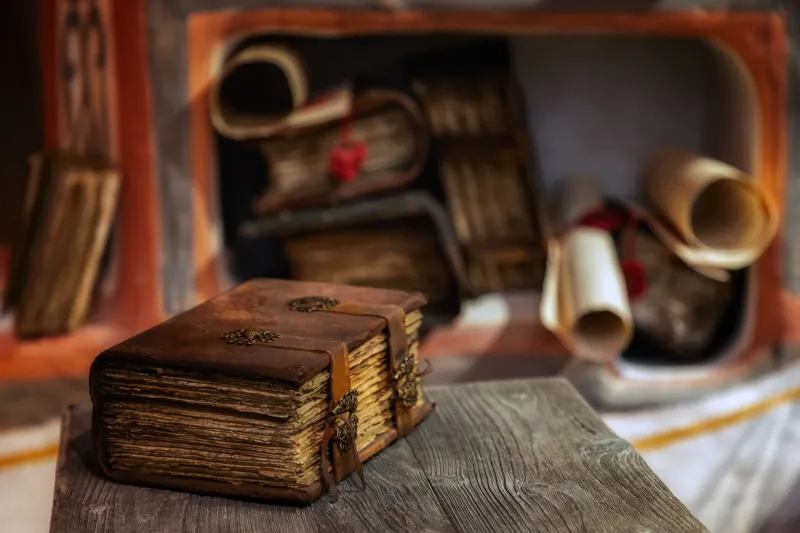
In Jewish tradition, documents that contain the name of God cannot simply be thrown away. They have to be stored and eventually given a formal burial. The storage space for these documents — usually a room attached to a synagogue — is called a geniza.
The Ben Ezra Synagogue in Cairo, one of the oldest in the world, had one of these rooms. And over the centuries, the community using it had a broad interpretation of what counted as sacred enough to preserve. Sacred texts, sure. But also letters. Business contracts. Marriage certificates. Shopping lists. Court documents. Personal correspondence. Medical receipts. Children's schoolwork.
Essentially anything written in Hebrew script — which, in medieval Jewish communities, covered an enormous range of everyday life — ended up in the room. For roughly a thousand years. Nobody threw any of it away.
By the time scholars started paying serious attention in the 1890s, the geniza contained somewhere between 300,000 and 400,000 individual documents and fragments, some dating back to the 9th century.
The Scholar Who Climbed Through the Window
Word of the Cairo Geniza had circulated quietly among European academics for years before anyone did much about it. Then, in 1896, a Scottish twin named Agnes Lewis brought a small fragment she'd purchased in Cairo to Solomon Schechter, a Romanian-born Jewish scholar then teaching at Cambridge University.
Schechter recognized immediately that the fragment was extraordinary — it appeared to be part of an ancient Hebrew text long thought to exist only in Greek translation. He traveled to Cairo, talked his way into the synagogue, and was shown to the geniza room.
His description of what he found inside has become one of the great moments in the history of scholarship: a floor-to-ceiling mass of documents, some fused together by age and moisture, others perfectly preserved, all of it piled in a space roughly the size of a large walk-in closet. Dust everywhere. Fragments of parchment, paper, and vellum layered like geological strata across centuries.
Schechter arranged to have roughly 140,000 documents shipped to Cambridge, where they became the core of what is now known as the Taylor-Schechter Geniza Collection. Other fragments ended up at institutions across the US and Europe. Scholars have been sorting through them ever since — and they're still not finished.
What Was Actually in There
This is where the story stops being about dusty manuscripts and starts being genuinely astonishing.
The Cairo Geniza didn't just preserve religious texts. It preserved the texture of ordinary life in medieval Jewish communities across the Mediterranean world — particularly in Egypt, but also in trade networks stretching from Spain to India. Historians had known these communities existed. They had almost no idea what daily life inside them actually looked like.
The documents changed that completely.
Among the fragments: letters from merchants complaining about late shipments of spices. Divorce proceedings with surprisingly candid testimony. Medical prescriptions. A letter from a man in Alexandria to his brother in Cairo asking for money and explaining, in some detail, why he needed it. Notes between business partners arguing over who owed what. A woman's letter to her husband who has been away too long on a trading voyage.
There are contracts for the sale of houses. Receipts for fabric. Correspondence about a shipment of cheese that went bad. A letter from a 12th-century merchant named Halfon ben Netanel, who appears in so many documents across the collection that scholars have been able to reconstruct significant portions of his life and business dealings across three continents.
The Princeton scholar S.D. Goitein spent 35 years working through Geniza documents and produced a six-volume masterwork called A Mediterranean Society that reconstructed medieval Jewish life in extraordinary detail. He described the Geniza as providing "a complete picture of a human society" — something almost no other historical source has ever offered for the medieval period.
The Thing Nobody Expected
What makes the Cairo Geniza genuinely strange — beyond the sheer improbability of its survival — is what it reveals about the limits of official history.
Historians tend to work with documents that were meant to be preserved: chronicles, royal decrees, religious treatises, official records. The Cairo Geniza is almost entirely the opposite. It's the stuff nobody was trying to save for posterity. The grocery lists and the squabbling letters and the receipts for cheese.
And it turns out that's exactly what was missing.
Because of one community's religious practice of never throwing away written documents, historians can now tell you what a merchant in 11th-century Cairo paid for pepper, how a woman in medieval Egypt negotiated her marriage contract, and what a student wrote to his parents when he needed more money for school.
Nobody planned for any of that to survive. It just did — because someone kept putting things in a room and never cleaning it out.
If that's not a vindication of the instinct to never throw anything away, it's hard to know what is.