Declared Dead, Found in the Drawer: The Animal That Fooled Science for Seventy Years
Science has a complicated relationship with the word "extinct." Sometimes it means gone. Sometimes it means we stopped looking in the right places. And occasionally — in ways that should probably make biologists a little more humble — it means we've been looking at it for decades without recognizing it.
The story of the Appalachian thread-footed caddisfly is that third kind of extinct.
A Funeral With No Body
The species in question — Triaenodes appalachius, for those keeping taxonomic score — was formally described in 1887 by an entomologist named Josiah Whitfield, who collected specimens from a handful of mountain streams in western North Carolina and eastern Tennessee. Whitfield noted the insect's distinctive larval case, its unusual leg morphology, and its apparent preference for cold, fast-moving water. He published his description, deposited his specimens at the Smithsonian, and moved on to other things.
For the next several decades, T. appalachius showed up occasionally in regional surveys. It wasn't common, but it wasn't alarming. Then, gradually, it stopped showing up at all.
By the early 1950s, two comprehensive surveys of Appalachian aquatic insects had failed to locate it. A 1953 review of freshwater invertebrate populations in the southern highlands listed it as "likely extirpated" — the scientific term for locally extinct. A follow-up paper in 1958 upgraded that assessment to simply "extinct," noting that habitat degradation from logging and agricultural runoff had probably eliminated the cold, clean stream conditions the species required.
The textbooks updated. The species joined the list. The file, more or less, closed.
The Thing About Museum Drawers
Here is something that non-scientists may not fully appreciate about natural history collections: they are enormous, they are understaffed, and they contain multitudes of things that have not been looked at carefully in a very long time.
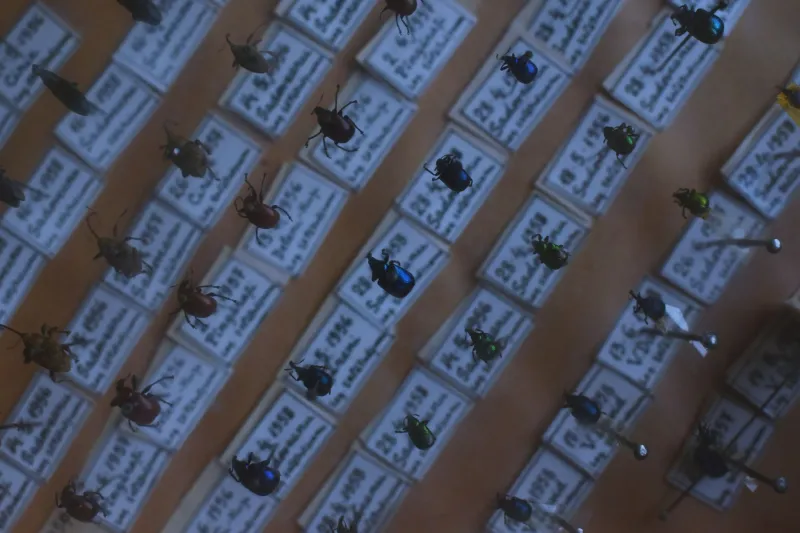
The Smithsonian's invertebrate collections alone hold millions of specimens. So do the collections at the American Museum of Natural History, the Field Museum in Chicago, the California Academy of Sciences, and dozens of university natural history departments scattered across the country. These specimens are cataloged, but cataloging is only as good as the identification that preceded it — and identification, especially for small insects collected in the field over a century ago, is a process that can go wrong in quiet, persistent ways.
When a specimen is misidentified, it gets filed under the wrong name. When it gets filed under the wrong name, it effectively disappears — present in the physical collection, absent from the scientific record.
This is what happened to Triaenodes appalachius.
One Graduate Student, One Afternoon, Seventy Years of Confusion
In the spring of 2019, a graduate student named Priya Nair was working on her dissertation at the University of Tennessee, focusing on the evolutionary history of caddisfly larval cases in the eastern United States. Caddisfly larvae build small protective tubes around themselves using materials from their environment — sand grains, plant fragments, tiny pebbles — and the architecture of these cases can be surprisingly diagnostic. Different species build differently.
Nair was working through a collection of specimens at the university's natural history museum, photographing larval cases for morphometric analysis, when she pulled a tray labeled Triaenodes ventralis — a common, well-documented species — and noticed something that didn't fit.
One specimen's larval case was wrong. Not dramatically wrong. Not obviously wrong to anyone who wasn't specifically looking at the geometry of how the case materials were arranged. But wrong in a way that Nair, who had spent two years staring at caddisfly cases, recognized immediately.
She pulled the specimen. She looked at the leg morphology. She looked at the wing venation. She went back to Whitfield's 1887 description.
She sat with it for a while.
Then she started making calls.
The Scope of the Oversight
What followed was a several-month process of working through museum collections with her advisor and two collaborating entomologists. They found T. appalachius — correctly identified, once you knew what you were looking for — in five separate institutional collections. The Field Museum had four specimens. The Smithsonian had seven, including two of Whitfield's original 1887 deposits that had apparently been re-sorted at some point in the early twentieth century and filed under the wrong species name.
There were specimens collected as recently as 2003. The species had been encountered, collected, preserved, and misfiled as something else, repeatedly, for decades after its official extinction.
Nair and her collaborators published their findings in 2021. The paper confirmed T. appalachius as extant — alive, not extinct — and included new field collections from three stream systems in North Carolina where the species was still present in modest but stable numbers.
The species' conservation status was updated accordingly. Its file, more or less, reopened.
What Seventy Years of Wrong Looks Like
The Appalachian thread-footed caddisfly was never gone. It was in the drawer the whole time, wearing someone else's name tag.
Nobody was negligent, exactly. Museum collections are vast. Caddisfly taxonomy is genuinely difficult. The species is small, brown, and subtle in ways that make misidentification understandable rather than embarrassing. The 1958 extinction assessment was made in good faith based on available field data.
But there's something quietly staggering about the image of it: a species declared dead, eulogized in textbooks, dropped from conservation concern — while its preserved bodies accumulated in climate-controlled drawers from Chicago to Washington, D.C., waiting for someone to look closely enough to recognize them.
Priya Nair looked. It took her one afternoon.
Sometimes the most extraordinary scientific discoveries aren't made in the field. Sometimes they're made by someone pulling a tray and thinking: that doesn't look right.