Seven Times a Target: The Impossible Survival Story of Roy Sullivan
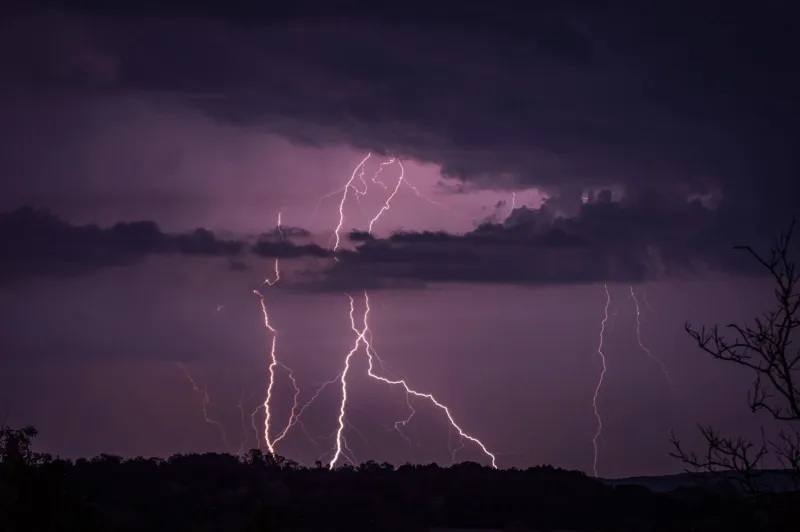
Seven Times a Target: The Impossible Survival Story of Roy Sullivan
If you've ever been told that lightning never strikes the same place twice, Roy Sullivan would like a word with you. Actually, he'd like several words, because he's had plenty of time to think about it while recovering from being electrocuted more times than most people experience thunderstorms.
The numbers alone sound fabricated. Between 1942 and 1977, Sullivan—a humble park ranger working in the Shenandoah National Park region of Virginia—was struck by lightning on seven documented occasions. Seven. The statistical probability of this happening to a single person in a single lifetime hovers somewhere between "winning the lottery" and "being abducted by aliens." Yet Sullivan lived through every strike, eventually earning an entry in the Guinness Book of World Records for his dubious distinction.
When Lightning Became Personal
Sullivan's first encounter with electricity from the sky occurred on July 12, 1942. He was working as a ranger when a sudden storm rolled through, and a lightning bolt found him with the precision of a heat-seeking missile. The strike burned a hole through his hat and singed his hair, but Sullivan survived with relatively minor injuries. At the time, he probably thought it was a freak accident—the kind of thing you tell at parties and then never think about again.
Then it happened again.
On July 7, 1969, nearly 27 years later, Sullivan was struck a second time while standing near a fire tower. The bolt knocked him unconscious and caused severe burns across his shoulder and chest. Recovery took weeks. The odds of being struck twice in a lifetime are already astronomical—roughly 1 in 500,000—but Sullivan wasn't done yet.
A Pattern Emerges
What makes Sullivan's story genuinely unsettling isn't just the frequency of the strikes, but the escalating circumstances surrounding each one. By the time the third strike came on August 7, 1969—just weeks after the second—people were starting to notice a pattern. Sullivan was struck while standing in his front yard. Then again in 1970, while fishing. Then in 1972, while working in the park. Each strike seemed to find him in ordinary moments, going about ordinary tasks.
The fourth strike came on April 16, 1972. The fifth on August 7, 1973. The sixth on June 5, 1976. The seventh and final documented strike occurred on June 25, 1977, when Sullivan was struck while working in a ranger station. By this point, Sullivan had become something of a local curiosity—a man seemingly marked by the sky itself.
The Science Behind the Stranger
Here's where the story shifts from pure anecdote into genuine scientific mystery. Meteorologists and physicians have spent considerable energy trying to understand how Sullivan survived each strike at all, let alone all seven.
Lightning carries roughly 300 million volts and heats the air around its path to temperatures five times hotter than the surface of the sun. Most people struck by lightning suffer severe burns, cardiac arrhythmias, neurological damage, or death. Sullivan should have been killed multiple times over.
One theory suggests that Sullivan may have had a particular body composition or electrical resistance that allowed him to channel the current more efficiently than most people. Another possibility involves the specific conditions of each strike—the type of ground contact, the angle of entry, the moisture content in the air. A third theory, more prosaic but perhaps more likely, involves simple probability and the fact that Sullivan spent an enormous amount of time outdoors in a region prone to thunderstorms. If you're in the woods long enough during storm season, eventually the odds catch up with you.
But none of these explanations fully account for the sheer improbability of the situation. Sullivan wasn't just struck by lightning; he was struck repeatedly, survived each time, and then continued working in the exact same environment where the strikes occurred.
Life After Lightning
Sullivan eventually retired from the Park Service and lived a quieter life, though he remained somewhat famous in his region. He gave interviews about his experiences and expressed his belief that he was simply unlucky—or perhaps lucky, depending on how you looked at it. He never moved away from Virginia. He never quit his job in the park. He simply accepted that he seemed to have some unusual relationship with electrical storms.
Sullivan passed away in 1994 at the age of 71, having survived not only seven lightning strikes but also the peculiar celebrity that came with them. His story remains one of the most thoroughly documented cases of lightning strike survival in medical literature, studied by researchers trying to understand the absolute limits of human resilience.
The thing about Roy Sullivan's story is that it sits right at the boundary between "this is impossible" and "this actually happened." We have the documentation. We have the medical records. We have photographs of a man who was struck by lightning seven times and lived to tell about it. And yet, it still sounds like someone made it up.