The Bridge That Danced
On the morning of November 7, 1940, the Tacoma Narrows Bridge began to dance. Not metaphorically—the 2,800-foot suspension bridge literally started undulating like a ribbon in the wind, twisting and rolling in motions that seemed to defy the laws of physics. By afternoon, one of America's most modern engineering marvels had twisted itself apart and collapsed into Puget Sound, taking with it every assumption engineers had made about how large structures behave.
 Photo: Puget Sound, via www.lakehomes.com
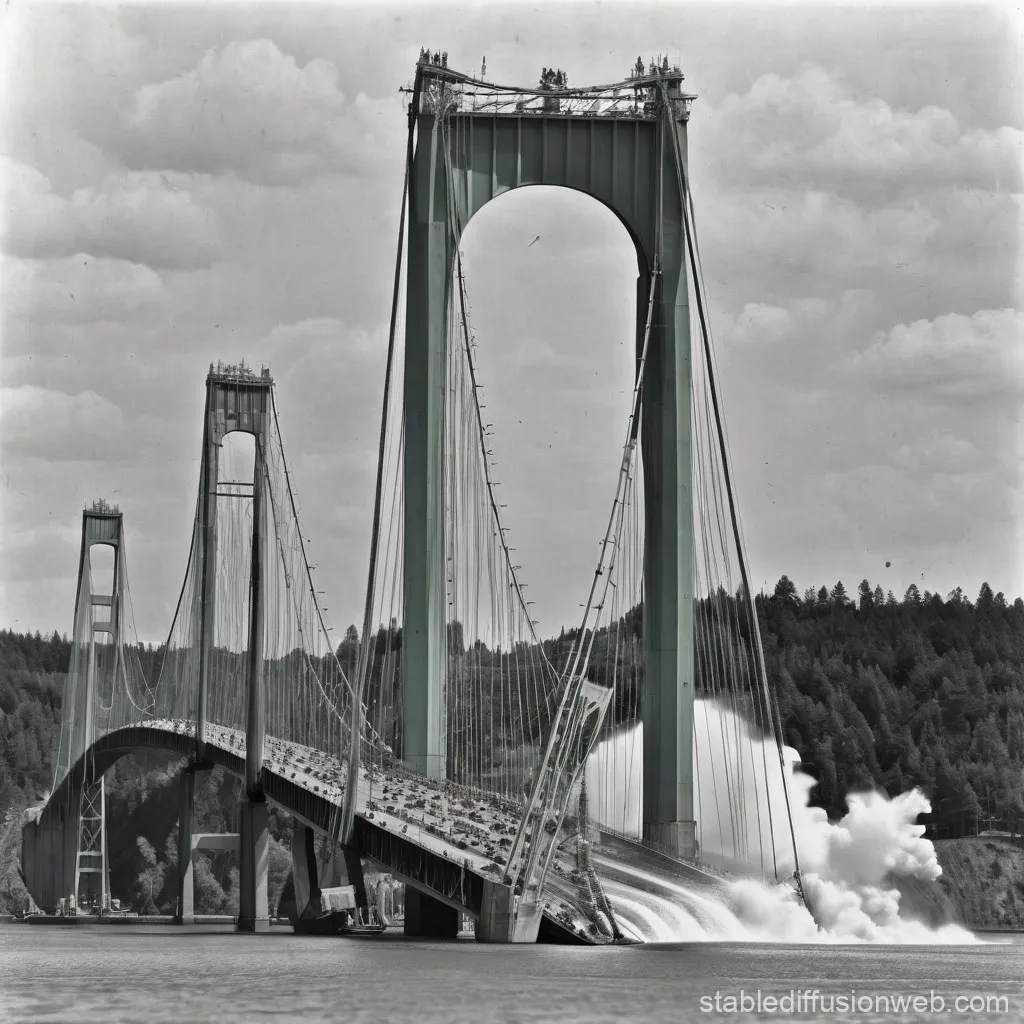 Photo: Tacoma Narrows Bridge, via imgcdn.stablediffusionweb.com
The collapse wasn't caused by hurricane-force winds, earthquakes, or structural overload. Instead, the bridge destroyed itself through a phenomenon that physicists understood but engineers had never seriously considered: resonance frequency, the same principle that allows an opera singer to shatter a wine glass with the right note.
Engineering Hubris Meets Natural Law
The Tacoma Narrows Bridge represented the cutting edge of 1930s engineering ambition. Designed to span the treacherous waters of Puget Sound with unprecedented elegance, the bridge featured a revolutionary design that prioritized aesthetics and cost savings over the conservative approaches that had guided bridge construction for decades.
Engineer Leon Moisseiff convinced Washington State officials that his sleek, narrow design could achieve the same strength as bulkier bridges while using less steel and creating a more graceful profile. The bridge's deck was only 39 feet wide—remarkably narrow for a structure of its length—supported by shallow plate girders that gave it an almost delicate appearance compared to the massive trusses of earlier suspension bridges.
The Warning Signs Nobody Heeded
From the day it opened in July 1940, the Tacoma Narrows Bridge exhibited disturbing behavior. Local residents nicknamed it "Galloping Gertie" because even moderate winds caused the deck to roll and pitch in ways that made driving across it a nauseating experience. Some drivers reported feeling seasick after crossing, while others found the motion so alarming that they abandoned their cars and walked.
Rather than investigating these warning signs seriously, engineers dismissed them as minor quirks that would settle down as the structure aged. The bridge's tendency to move was actually seen as a positive feature by some officials, who argued that flexibility prevented the kind of catastrophic failures that had destroyed more rigid structures in the past.
The Science of Self-Destruction
What engineers failed to understand was that the bridge's narrow, flexible design had created a perfect resonance chamber. When wind hit the bridge deck at specific angles and speeds, it generated vortices—spinning columns of air that peeled off alternately from the top and bottom of the structure. These vortices pushed and pulled the bridge in a rhythmic pattern that matched its natural frequency of vibration.
This phenomenon, called vortex shedding, is the same force that makes telephone wires hum in the wind or causes flags to flutter. But when the frequency of the wind-generated vortices matched the bridge's natural resonance frequency, the structure began to absorb energy from every gust, building up oscillations like a child pumping their legs to swing higher.
The Day Physics Won
On November 7, 1940, sustained winds of only 42 miles per hour—far below the bridge's designed wind load—hit the structure at precisely the wrong angle. The bridge began its familiar rolling motion, but this time the oscillations didn't dampen out as they had before. Instead, they grew stronger with each cycle, fed by the steady rhythm of vortex shedding.
Professor F.B. Farquharson from the University of Washington happened to be on the bridge that morning, documenting its unusual behavior for a research project. His film footage captured the bridge's final hour as it twisted and writhed with increasing violence, the roadway eventually rotating nearly 90 degrees before the main span broke apart and plunged into the sound below.
The Footage That Changed Everything
Farquharson's film of the collapse became one of the most famous disaster documentaries ever recorded, but its scientific value proved even more important than its dramatic impact. Frame-by-frame analysis revealed exactly how resonance frequency had amplified small wind forces into destructive oscillations that overwhelmed the bridge's structural capacity.
The footage showed that the bridge hadn't failed due to excessive stress in any traditional sense—the steel cables and towers remained largely intact even as the deck twisted apart. Instead, the structure had been destroyed by motion itself, vibrating with such violence that the roadway literally shook itself to pieces.
Rewriting the Rules of Engineering
The Tacoma Narrows collapse forced a complete revolution in bridge design philosophy. Engineers realized they had been focusing so intently on static loads—the weight of traffic, snow, and dead structural elements—that they had ignored dynamic forces like wind-induced vibration and resonance effects.
Every major bridge built after 1940 incorporated lessons learned from Tacoma Narrows. Modern suspension bridges feature much wider, heavier decks that resist twisting, along with aerodynamic modifications that break up vortex formation. Wind tunnel testing became mandatory for large structures, and engineers developed sophisticated computer models to predict how bridges would respond to various wind conditions.
The Legacy of Galloping Gertie
The original Tacoma Narrows Bridge lasted only four months, but its catastrophic failure probably prevented hundreds of similar disasters by forcing engineers to confront the complex relationship between structure and motion. The replacement bridge, completed in 1950, incorporated every lesson learned from its predecessor's destruction and has withstood decades of Pacific Northwest weather without incident.
Today, Farquharson's footage is still shown in physics and engineering classrooms worldwide as a dramatic demonstration of resonance frequency in action. The collapse serves as a permanent reminder that understanding natural laws isn't enough—engineers must also respect them, even when those laws seem to conflict with aesthetic preferences or budget constraints.
When Nature Sets the Rules
The Tacoma Narrows Bridge collapse remains one of the most spectacular examples of what happens when human engineering meets immutable physical laws. The bridge didn't fail because its designers were incompetent or careless—it failed because they didn't fully understand the forces they were dealing with. In the end, physics always wins, and the bridge that danced itself to death taught engineers to listen more carefully to what nature was trying to tell them.
The disaster proved that sometimes the most dangerous enemy of good engineering isn't ignorance—it's the confidence that comes from incomplete knowledge.