No Help, No Escape, No Choice: The Doctor Who Cut Himself Open in Antarctica
There are moments in history that make you put down whatever you're doing and just stare at the wall for a minute.
This is one of them.
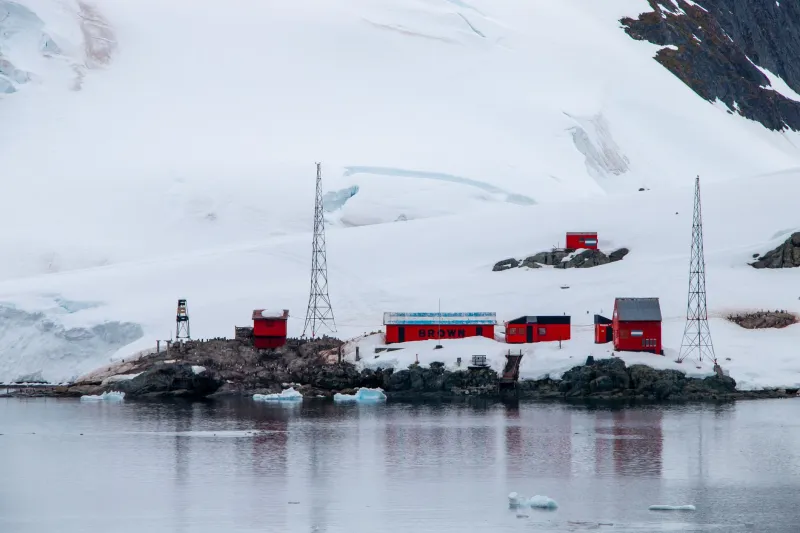
In April 1961, a 27-year-old Soviet physician named Leonid Rogozov was stationed at Novolazarevskaya, a remote Soviet research base sitting on the edge of the Antarctic continent. He was the only doctor on a team of 13 scientists. The Antarctic winter had fully closed in. Rescue flights were impossible. The nearest hospital was roughly 15,000 miles away. And then his appendix started to go.
The Worst Possible Timing
Appendicitis is the kind of medical emergency that, in most parts of the world, gets you a quick ambulance ride and a routine surgery. It's serious, yes — a ruptured appendix can kill you within days — but it's also one of the most commonly treated conditions in modern medicine. Millions of people have had their appendix removed and gone home two days later.
Rogozov did not have the option of routine anything.
He first noticed the symptoms on April 29th: fatigue, a dull ache in his lower right abdomen, a low fever. He knew immediately what it was. He was, after all, a doctor. He also knew exactly what it meant. Without surgical intervention, a ruptured appendix would cause peritonitis — a catastrophic infection of the abdominal cavity — and he would be dead within two weeks, give or take.
For the first day, he tried everything a physician could do without a scalpel. He rested. He took antibiotics. He hoped. By May 1st, the pain had intensified significantly and his temperature was climbing. The antibiotics weren't touching it. The appendix was not going to resolve on its own.
Rogozov wrote in his journal: "I did not sleep at all last night. It hurts like the devil."
He made his decision.
Becoming Your Own Patient
What Rogozov did next required a particular kind of cold, methodical courage that most of us will never be asked to produce. He spent two days mentally preparing and organizing his equipment. He briefed two of his colleagues — a meteorologist and a driver — on how to hand him instruments and hold a mirror so he could see what he was doing. He positioned a small angled mirror over his abdomen. He administered a local anesthetic to his own skin.
Then he picked up a scalpel and made the first incision.
The surgery took approximately one hour and 45 minutes. Working at an awkward angle — he couldn't fully sit up — and quickly losing strength from the effort, Rogozov located the inflamed appendix, clamped and removed it, and sutured the wound closed. He noted in his own medical records that the appendix had been very close to rupturing. He had made it just in time.
At one point during the procedure, he felt faint and had to pause for several minutes. He kept going.
He was fully recovered within two weeks.
The Part That Makes It Even More Remarkable
Here's what tends to get lost in the headline version of this story: Rogozov didn't just survive. He went back to work.
After his recovery, he continued his duties as the station physician for the remainder of the expedition. He returned to the Soviet Union later that year, completed his medical career, and eventually became a respected physician in St. Petersburg. He gave occasional interviews about the experience but was, by most accounts, characteristically modest about the whole thing. He described it less as a feat of heroism and more as a problem he needed to solve.
His journal entry from the night after the surgery reads, in part: "I worked without gloves. It was hard to see. The mirror helped, but it was still reversed. I had to think about that."
The mirror. He had to think about the mirror reversing the image while he was operating on his own abdomen. With no gloves.
Why This Story Still Matters
Rogozov's self-surgery became a celebrated case study in Soviet medical literature, and his story has been periodically rediscovered by Western audiences in the decades since. His son, also a physician, helped publish a detailed account of the event in the British Medical Journal in 2009, bringing it to a wider international readership.
But beyond the jaw-dropping mechanics of the thing, what makes the story linger is what it says about human adaptability under pressure. Rogozov didn't panic. He didn't despair. He assessed the situation, gathered his resources, and did the work. He was scared — his journal makes that clear — but he separated the fear from the task.
Most of us will never face anything remotely like what Leonid Rogozov faced in that Antarctic research station in 1961. But the image of a man calmly operating on himself by mirror-light, pausing when he felt faint, then continuing — that's the kind of thing that quietly recalibrates what you think a person is capable of.
He died in 2000. He was 66 years old. His appendix had been gone for nearly four decades by then — removed by his own hands, in a room full of ice and improvised instruments, at the end of the world.