Sixty Years of Explosions Couldn't Erase This Island — Or What It Meant
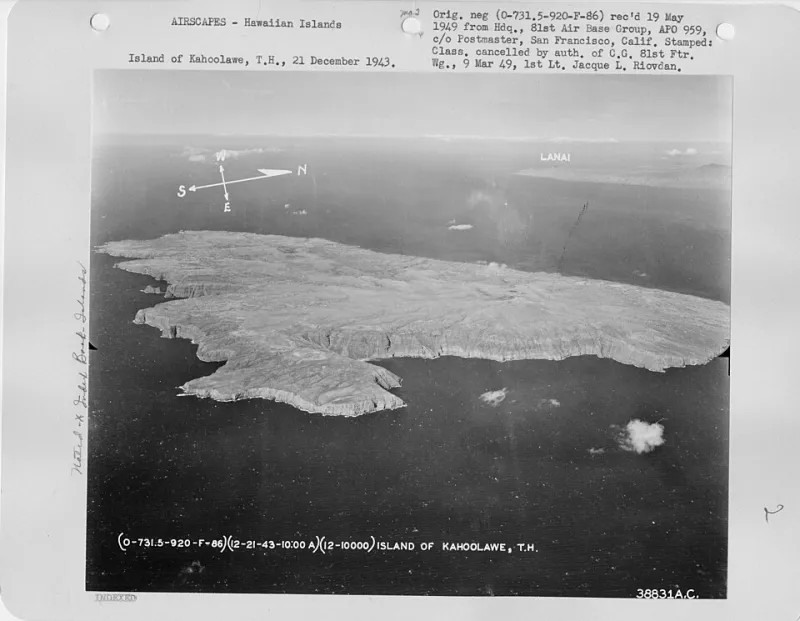
Photo: Unknown authorUnknown author or not provided, Public domain, via Wikimedia Commons
The Target That Wouldn't Die
Picture a military planner's checklist: an island, uninhabited, arid, only about 45 square miles. No residents to relocate, no crops to ruin, no towns to evacuate. Just dry volcanic soil, scrubby brush, and a location conveniently in the middle of the Pacific. From a desk in Washington, it must have looked like the perfect practice target — a place designed by geography itself to absorb explosions.
That island was Kahoʻolawe, the smallest of the eight main Hawaiian Islands, sitting about seven miles southwest of Maui. And starting in 1941, the United States Navy did exactly what the checklist implied: it bombed Kahoʻolawe. Repeatedly. Relentlessly. For more than fifty years.
An Island Written Off as Expendable
The logic behind choosing Kahoʻolawe wasn't malicious so much as brutally practical. After the attack on Pearl Harbor, the Pacific became the most important theater of war on Earth, and sailors needed somewhere to rehearse amphibious landings, aerial bombardment, and naval gunnery. Kahoʻolawe had almost nothing on it. Drought had kept permanent settlement minimal for centuries — ancient Hawaiians had used the island, but its harsh conditions meant no thriving population to displace.
So the Navy took it. Under a wartime executive order, the island became a live-fire training ground, and it stayed that way through World War II, Korea, Vietnam, and beyond. By some estimates, more ordnance fell on Kahoʻolawe than on any other single piece of American soil. Whole sections of the island were reshaped. Unexploded shells littered the terrain like poisonous gravel.
But here's the thing the paperwork missed: Kahoʻolawe was never empty of meaning. In Hawaiian tradition, the island is tied to Kanaloa, the deity associated with the ocean and navigation. To Native Hawaiians, it wasn't a blank spot on a map. It was a place with a name, a history, and a spirit — and watching it get blown apart for decades felt less like training and more like desecration.
Nine Fishermen and One Impossible Idea
By the 1970s, the Hawaiian cultural renaissance was gathering steam — a movement to reclaim language, hula, land rights, and identity that had been suppressed for generations. And Kahoʻolawe became its rallying point in the most literal way possible.
In January 1976, a small group of activists calling themselves Protect Kahoʻolawe ʻOhana set out from Maui in fishing boats, determined to land on the island despite the bombing and the Navy's prohibition. Getting there meant crossing open ocean in small craft. Being caught meant arrest. Being there meant walking on ground studded with unexploded ordnance.
They went anyway. And they kept going — again and again, through the late 1970s and early 1980s, in what became known as the Kahoʻolawe occupations. Some of the most respected figures in modern Hawaiian activism made those illegal crossings. Their argument was simple and devastating: how could the state of Hawaii be a place where a sacred island could be used for target practice without the consent of the people whose homeland it was?
The occupations worked — not immediately, but eventually. Lawsuits followed. In 1980, the Navy agreed to allow limited access for cultural and environmental purposes. And in 1990, President George H.W. Bush ordered a halt to live-fire training on the island. A few years later, Congress formally transferred Kahoʻolawe back to the state of Hawaii, to be held in trust for a future Native Hawaiian sovereign entity.
Cleaning Up a Bombing Range Is Harder Than Making One
Here's where the story turns from triumphant to almost darkly comic. The Navy was required to clear the island of unexploded ordnance before handing it back. The problem: nobody on Earth had ever attempted anything like it. Kahoʻolawe wasn't a battlefield with a few thousand leftovers. It was an entire island saturated with decades of shells, bombs, and rockets, many of them buried, corroded, or fused into the soil.
The cleanup, which ran through the 1990s and into the 2000s, removed tens of thousands of pieces of ordnance — and cost hundreds of millions of dollars. Even then, it was never finished. Congress eventually capped the funding, and large portions of Kahoʻolawe remain off-limits to this day because the ground is simply too dangerous to walk on. An island nobody could fully destroy turned out to be an island nobody could fully repair.
What Refused to Sink
Today, access to Kahoʻolawe is still restricted. Volunteers make trips to plant native species, restore watersheds, and slowly nurse the island back toward ecological health. It remains uninhabited in the conventional sense — but it is anything but abandoned.
The strange genius of this story is the inversion at its center. The Navy treated Kahoʻolawe as the most expendable land in America, a place whose only value was its capacity to take punishment. The activists treated it as priceless. Half a century of explosions settled nothing. What couldn't be bombed out of existence was the idea of the island itself — and that, in the end, is the part that came back.